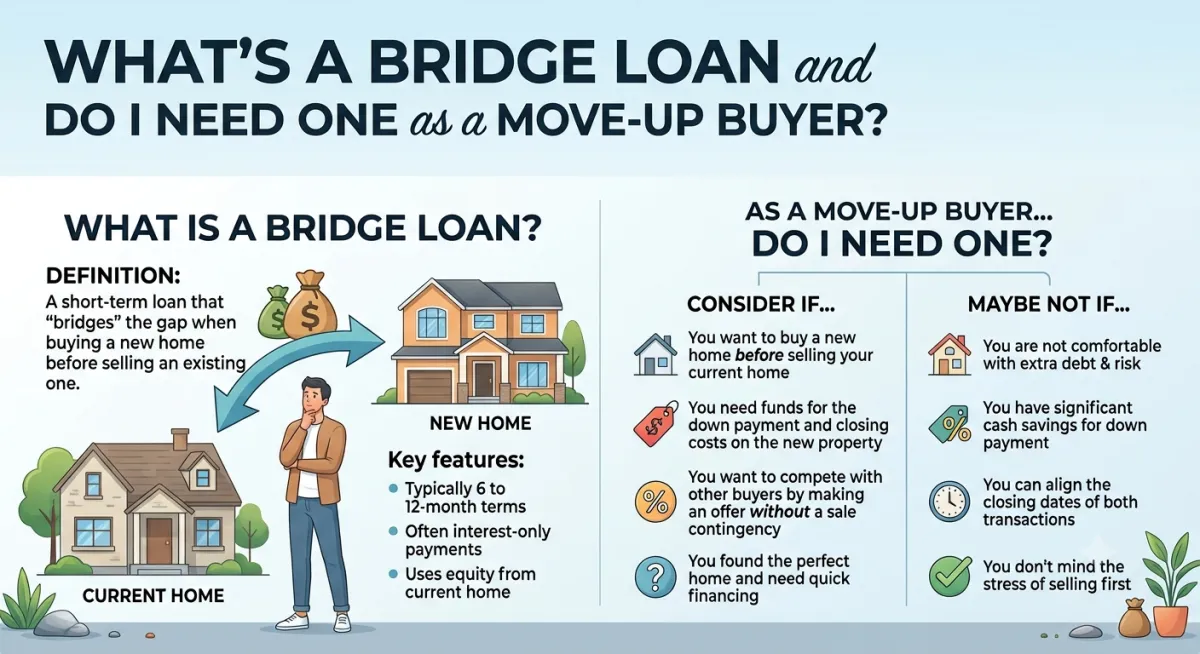
What's a Bridge Loan and Do I Need One as a Move-Up Buyer?

If you're a move-up buyer who wants to purchase your next home before your current one sells, you've probably heard the term "bridge loan" thrown around - usually without much explanation of what it actually means. Here's the plain-language version.
What a Bridge Loan Actually Is
A bridge loan is short-term financing that lets you borrow against the equity in your current home so you can use those funds toward the purchase of your next one - before your current home has actually sold. It's meant to "bridge" the gap between buying and selling, hence the name.
In practice, that usually means the loan covers things like your down payment and closing costs on the new home, using your existing home's equity as collateral. Once your current home sells, you pay off the bridge loan with the proceeds.
Why Move-Up Buyers Consider Them
The appeal is straightforward: you can make an offer on your next home without a sale contingency, move once instead of twice, and avoid the scramble of finding temporary housing between closings. In a competitive market, a non-contingent offer is also simply a stronger offer - sellers tend to prefer buyers who aren't waiting on another sale to fall into place.
What to Actually Weigh Before Getting One
Bridge loans solve a real problem, but they're not free, and they're not automatic. A few things worth understanding before you assume this is your path:
* They typically cost more than a standard mortgage. Higher interest rates and additional fees are common, since lenders are taking on short-term risk.
* Qualification isn't guaranteed. Lenders will look closely at your equity position, your income, and your ability to carry both properties temporarily if needed. This is a conversation to have with a lender early, not an assumption to build a plan around.
* They're short-term by design. Bridge loans are meant to be paid off quickly, usually once your current home sells - they're not a long-term financing solution.
* Your current home still has to sell. A bridge loan reduces the stress of timing, but it doesn't eliminate the underlying need to sell your existing home at a reasonable price within a reasonable window.
Is It Right for You?
A bridge loan tends to make the most sense when:
* You have significant equity in your current home
* You're buying in a competitive market where a contingent offer would put you at a real disadvantage
* You'd rather pay for short-term financing than move twice or rent temporarily
It tends to make less sense when:
* Your equity position is thin
* You're comfortable with a rent-back arrangement or short-term move instead
* The cost of the loan outweighs the convenience it buys you
The Bottom Line
A bridge loan isn't the only way to manage buying before selling - a rent-back agreement or a sale-contingent offer are both worth considering too - but for the right buyer in the right equity position, it can make a move-up purchase far less stressful. The right move depends entirely on your numbers, so this is genuinely a conversation to have with a lender before you fall in love with a house you're not sure you can structure the financing for.
If you're considering this route, I'm happy to walk through what your specific equity position and timeline would actually support.
________________________________
Bonnie Fleishman has specialized in waterfront and move-up real estate across Anne Arundel County for 36 years, serving Pasadena, Glen Burnie, Severna Park, Arnold, Crofton, Gambrills, and Annapolis. This post is general information, not financial advice - for guidance specific to your situation, consult your lender.