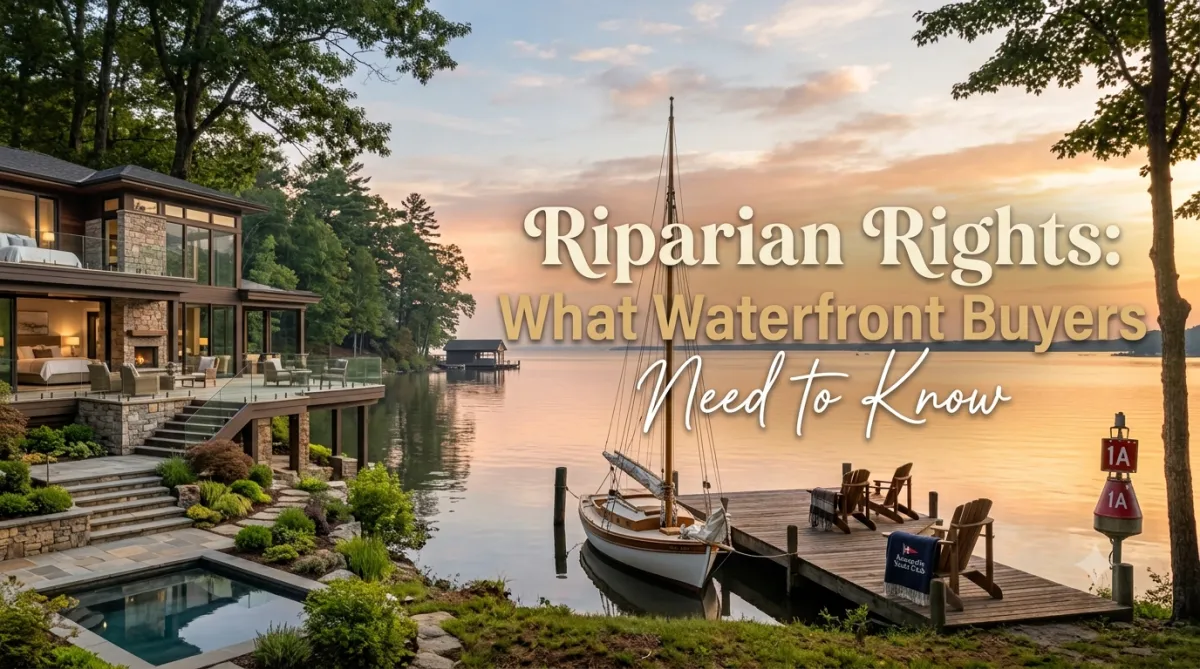
Riparian Rights: What Waterfront Buyers Need to Know
Every waterfront buyer hears the term "riparian rights" at some point, and most assume it just means owning the water. It doesn't work that way in Maryland, and understanding the actual rules matters before you fall in love with a house.
The State Owns the Water
Here's the part that surprises people first. In Maryland, the state owns the land under nearly all navigable water, including the Chesapeake Bay and its tributaries. You don't buy the water itself. What you buy, as a riparian owner, is a bundle of rights tied to your property's connection to that water.
What Riparian Rights Actually Give You
For a property to carry true riparian rights, the deed has to reach the water, with no reservation that cuts those rights off. When it does, you typically get:
* The right of access to the navigable water in front of your property
* The right to build a pier, wharf, or dock, subject to permits and public regulations
* The right to accretion, meaning any land gradually added by natural water movement becomes yours
* The right to use the water without transforming it, and to defend your land against erosion
These rights transfer with the property when you sell. They also can't be used to intrude on your neighbor's version of the same rights, which is where a lot of waterfront disputes actually start.
Waterfront, Water-Privileged, and Water-View Aren't the Same Thing
This trips up a lot of buyers, so it's worth being precise:
* Waterfront with riparian rights means your deed reaches the water. You have access, pier rights, and the rest of the bundle.
* Water-privileged usually means shared community access, a beach, or a pier through an HOA, without your own deed reaching the water.
* Water-view means exactly what it sounds like. You can see the water, but you have no legal control over it, no guaranteed access, and no right to stop a neighbor from building something that blocks your view.
Knowing which one you're actually buying changes everything about what you can do with the property later.
What About the View Itself?
Maryland law doesn't specifically protect a water view the way it protects access and pier rights. That surprises people too. In practice, courts have found ways to protect a waterfront owner's view as part of the broader riparian bundle, but it's not as clean or guaranteed as the right to build a dock. If a water view matters to your decision, don't assume it's protected. Ask specific questions before you buy.
Permits, Regulations, and the Critical Area
Riparian rights aren't unlimited. Piers and docks require permits. Anne Arundel County and the state both regulate construction near the water through Critical Area rules designed to protect the Chesapeake Bay. Before you assume you can build or expand a pier, check what's actually allowed on that specific property. What the current owner has isn't always what a new owner can add.
What Every Waterfront Buyer Should Check
* Does the deed actually reach the water, or is this a water-privileged or water-view property instead?
* What permits exist for any existing pier, dock, or bulkhead?
* Is the property in a Critical Area with added restrictions?
* Are there any recorded easements or shared-access agreements with neighbors?
A real estate attorney or a title search can answer these clearly. Don't rely on assumptions, and don't rely on what the listing says without confirming it.
The Bottom Line
Riparian rights are one of the most valuable parts of owning waterfront property in Maryland, but they're also one of the most misunderstood. Knowing exactly what you're buying, access, pier rights, accretion, and the limits that come with all of it, protects you from a very expensive surprise down the road.
If you're shopping for waterfront and want a clear read on what a specific property's rights actually include, I'm happy to walk through it with you.
________________________________
Bonnie Fleishman has specialized in waterfront and move-up real estate across Anne Arundel County for 36 years, serving Pasadena, Glen Burnie, Severna Park, Arnold, Crofton, Gambrills, and Annapolis. This post is general information, not legal advice. For guidance specific to a property, consult a Maryland real estate attorney.