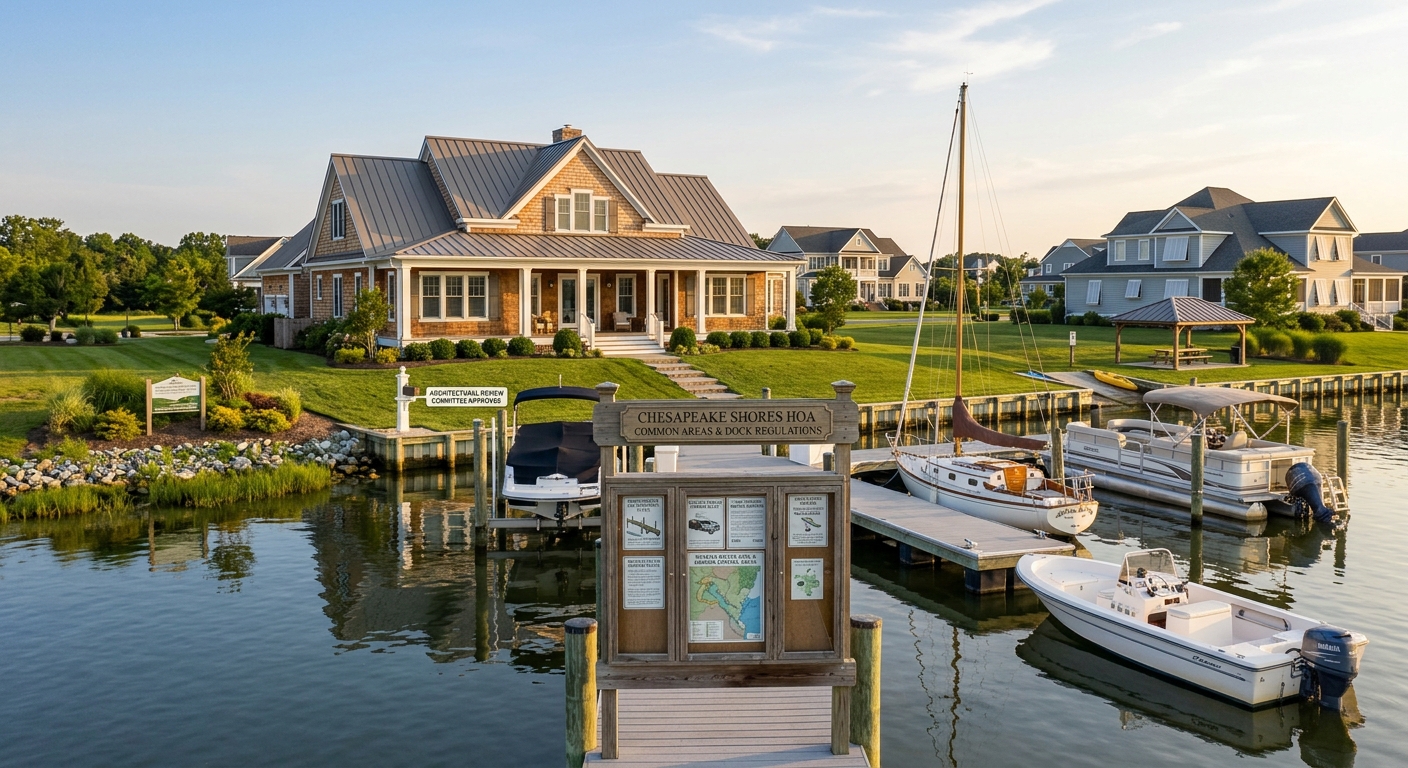
How Does an HOA Affect My Waterfront Home Purchase?

A lot of the water-privileged communities in this county, the ones with a shared beach, a community pier, or slip access, run through a homeowners association. That's not a red flag. It's actually usually the reason the water access exists at all. But it does mean there's real homework to do before you buy.
Why Waterfront and HOAs Go Together So Often
If your deed doesn't reach the water directly, the water access you're buying almost always comes through some form of community governance, and that means someone, whether it's a mandatory HOA, a voluntary improvement association, or a county special tax district, is managing it. Someone has to maintain the beach, the pier, the boat ramp, the parking, and decide who gets access and how. Understanding which structure you're actually buying into matters just as much as the water access itself.
It's Not Always a Traditional HOA
Here's an important distinction, especially in this county's older waterfront communities: not every water-privileged neighborhood has a mandatory HOA in the way people usually picture one.
Many older communities are instead run by a voluntary improvement association. Membership isn't required, and neither are dues, but the amenities usually are. Want access to the community boat ramp? You may need to pay separately for a ramp key. Want beach access? Same idea. It's an opt-in system, which means your neighbor next door might have full water access while you have none, simply based on whether they've paid into it.
Other older communities sit in a special tax district, set up through the county rather than a private association. In these, every property owner is charged a special tax, added right onto the property tax bill, specifically to maintain the community beach, pier, or other shared property. This setup usually exists because there was never a formal HOA established when the community was built, so the county stepped in to create a mechanism for funding upkeep instead.
Both of these are common in this area, and both are very different from a standard mandatory HOA. Before you assume how a community handles its water access, ask directly: is this a voluntary improvement association, a special tax district, or a traditional HOA? The answer changes what you'll actually pay, and what you're actually guaranteed.
What to Actually Read Before You Buy
The governing documents, not the HOA's summary of them. Bylaws, covenants, and rules should spell out exactly what water access you're buying into: beach rights, pier or slip access, boat storage, and any waitlist or transfer process for a new owner.
The financials. Ask for the HOA's reserve study and recent budget. A community with healthy reserves can handle a failing bulkhead or a pier repair without a surprise assessment. A community with thin reserves may hit you with a large bill not long after you move in.
Recent meeting minutes. These often reveal what a summary won't: ongoing disputes, planned assessments, or maintenance projects already in motion.
Current dues, and how they've trended. Waterfront amenities cost more to maintain than a standard neighborhood entrance sign. Ask what dues have done over the past five years, not just what they are today.
Questions Specific to Water Access
* Is slip or beach access guaranteed with the property, or is there a waitlist, even for existing residents?
* Are there restrictions on boat size, type, or usage tied to community water access?
* Who's responsible for maintaining the pier, bulkhead, or beach, the HOA or individual owners?
* Has the community had any major water-related repairs recently, or any planned?
The Trade-Off Worth Understanding
An HOA in a water-privileged community usually means you get water access without owning or maintaining a private dock yourself, often at a fraction of what a private waterfront property costs. That's a real advantage. The trade-off is less control: you don't set the maintenance schedule, you don't decide the rules, and dues can rise if a major repair comes up. For a lot of buyers, that trade is absolutely worth it. It's just worth understanding clearly before you're the one voting on the special assessment.
The Bottom Line
An HOA isn't something to fear in a water-privileged community, it's often the reason the water access exists in the first place. But it deserves real due diligence: read the actual governing documents, check the reserves, and ask specific questions about how water access is actually guaranteed to a new owner. That's what separates a great water-privileged purchase from an expensive surprise.
If you're looking at a water-privileged community and want help sorting through the HOA details before you write an offer, I'm happy to walk through it with you.
________________________________
Bonnie Fleishman has specialized in waterfront and move-up real estate across Anne Arundel County for 36 years, serving Pasadena, Glen Burnie, Severna Park, Arnold, Crofton, Gambrills, and Annapolis. This post is general information, not legal advice. For guidance specific to a property, review the HOA's governing documents directly and consult a Maryland real estate attorney.