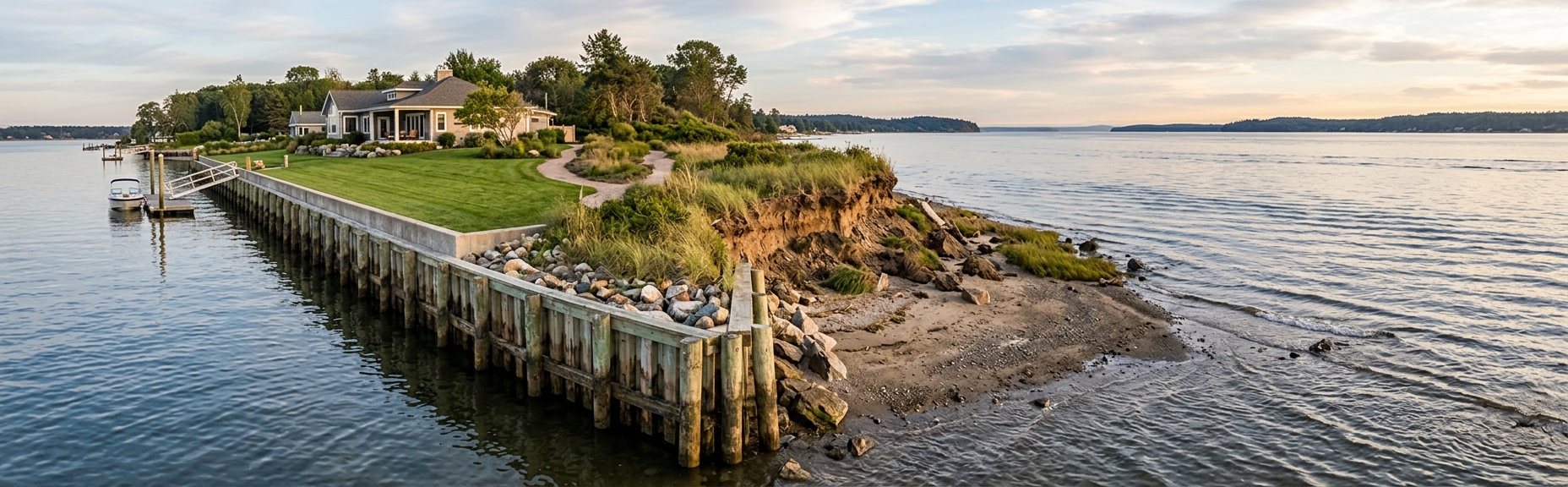
What Should I Know About Bulkheads and Erosion Before Buying Waterfront?

A pretty shoreline in a listing photo doesn't tell you what it costs to protect, or whether you're even allowed to protect it the way you'd assume. Bulkheads and erosion are two of the most misunderstood parts of waterfront ownership, and both are shaped by rules most buyers have never heard of until they own the property.
You're Probably in the Critical Area, and That Matters
If your property sits within 1,000 feet of tidal water or tidal wetlands, you're in Maryland's Chesapeake Bay Critical Area, a protective zone established back in 1984 to slow the decline of the Bay's water quality. Anne Arundel County adopted its own Critical Area Program in 1988, and it governs a lot more than people expect: grading, clearing vegetation, pruning, and any shoreline construction.
Inside that zone, the closest 100 feet to the water, called the Critical Area Buffer, carries even stricter rules, and that buffer can expand up to 300 feet in areas with steep slopes, highly erodible soils, or other sensitive conditions. Before you assume what you can build or clear on a waterfront lot, check where the buffer actually falls on that specific property.
Here's What Surprises Most Buyers: Bulkheads Aren't the Default Anymore
A lot of people assume a bulkhead is simply how you protect a shoreline. Maryland's actual policy works the other way. The state's preferred order for erosion control starts with no action at all, then relocating threatened structures, then non-structural methods like marsh creation, beach nourishment, and slope grading. Bulkheads sit at the very bottom of that list, generally restricted unless there's no practical natural alternative, for example, severe erosion combined with a high bluff or dense woodland that blocks any other approach.
That means you should never assume a new bulkhead will be approved just because the last owner had one, or just because a neighboring property has one. Every shoreline stabilization project needs its own permit and its own buffer management plan.
What This Means If You're Buying a Property With an Existing Bulkhead
An existing, legally permitted bulkhead is different from building a new one. Repairing and maintaining a structure that's already there is usually more straightforward than installing one from scratch. But "usually" isn't "always." Before you buy:
* Confirm the bulkhead was legally permitted, not just built without documentation
* Ask about its age. Bulkheads generally last 20 to 40 years, and failure tends to happen suddenly, not gradually
* Understand that replacing a failing bulkhead still requires going through the permitting process again, it's not an automatic like-for-like swap
Living Shorelines Are Often the Better Option Now
For buyers dealing with real erosion and no existing structure, a living shoreline, marsh creation, vegetation, and natural material rather than a hard wall, is often both the state's preferred approach and a genuinely effective one. It tends to be more resilient over time, better for the surrounding habitat, and more likely to be approved by the county. It's worth exploring before assuming a bulkhead is the only path.
What to Ask Before You Buy Waterfront
* Is the property in the Critical Area, and where does the buffer fall on this specific lot?
* Is there an existing bulkhead, and is it properly permitted?
* How old is it, and has it shown any signs of failure?
* Has this shoreline experienced significant erosion, and is there a management plan in place?
* What would it actually take, permit-wise, to repair, replace, or add shoreline protection here?
The Bottom Line
Erosion and shoreline protection aren't things to fear on a waterfront property, but they are things to understand clearly before you close. The rules here are more protective, and more specific, than most buyers expect, and assuming you can simply build or rebuild a bulkhead the way the last owner did isn't a safe bet. Know what you're working with before you fall in love with the view.
If you're shopping for waterfront and want a clear read on a specific property's Critical Area status or shoreline condition, I'm happy to help you look into it.
________________________________
Bonnie Fleishman has specialized in waterfront and move-up real estate across Anne Arundel County for 36 years, serving Pasadena, Glen Burnie, Severna Park, Arnold, Crofton, Gambrills, and Annapolis. This post is general information, not legal or engineering advice. For guidance specific to a property, consult Anne Arundel County Planning and Zoning and the Maryland Department of the Environment.